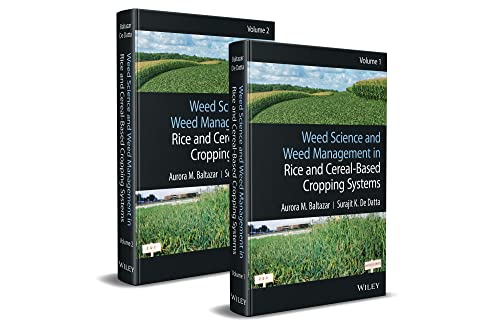
Weed science and weed management in rice and cereal-based cropping systems / Aurora M. Baltazar, Surajit K. De Datta.
Material type: TextPublisher: Hoboken, NJ : Wiley, 2023Edition: First editionDescription: vol. 1,xxii,376 p.: ill.; 24cmContent type:
- text
- unmediated
- volume
- 9781119737568
- 9781394180752
- 9781394180769
- 633.18 23/eng/20230111 BAW
- Also available online.
| Item type | Current library | Call number | Copy number | Status | Barcode | |
|---|---|---|---|---|---|---|
 Books |
Central Library, SAU General Stacks | 633.18 BAW (Browse shelf(Opens below)) | 2 | Available | 0011322 | |
|
Books
|
Central Library, SAU General Stacks | 633.18 BAW (Browse shelf(Opens below)) | 1 | Not For Loan | 0010854 |
Browsing Central Library, SAU shelves, Shelving location: General Stacks Close shelf browser (Hides shelf browser)


Includes index.
v. 1. -- v. 2.
Chapter 1. -- Weeds: history, definition, classification, harmful and beneficial effects -- Chapter 2. -- Weed biology: Weed growth, reproduction, nature of crop-weed competition -- Chapter 3. -- Weed ecology: Weediness and adaptation -- Chapter 4. -- Rice and Rice-Based Cropping Systems -- Chapter 5. -- Mechanical, Cultural, Physical and Integrated Weed Management -- Chapter 6. -- Chemical control: Principles of Herbicide Use -- Chapter 7. -- Herbicides: Classification, uses, modes of action and target sites -- Chapter 8. -- Herbicide-resistant weeds in rice: history, causes, management -- Chapter 9. -- Biological control and use of bioherbicides -- Chapter 10. -- Biology and management of some problem weeds -- Chapter 11. -- Rice-Wheat and other Wheat-based Cropping Systems -- Chapter 12. -- Corn-soybean and rice-corn-soybean cropping systems -- Chapter 13. -- Weed science and weed management: current issues and future perspectives.
"Weed Science and Weed Management in Rice and Rice-Based Cropping Systems will describe the history, production systems and practices of rice cropping systems in major rice-growing countries, and how the unique production practices affect crop-weed relationships which in turn affect weed management practices. It will also attempt to provide an understanding of the basic weed science principles as they apply to tropical cropping situations to be able to compare how weeds behave under multi-crop tropical systems and mono-crop mechanized temperate cropping systems. The ultimate purpose is to be able to apply these basic principles in order to develop improved, efficient, and economically and environmentally sustainable strategies in managing or controlling weeds. This book will discuss the various management methods: chemical, cultural, mechanical, biological, integrated, focusing on the most recent research, particularly on new herbicide chemistries and modes of action, molecular biology and weed genomics and on evolution of herbicide-resistant weeds. For non-chemical (mechanical) control, it will focus on recent developments on robotics and automated weed control and for biocontrol, on the new bioherbicides derived from plant and microbial toxins being developed in the past 5 years. On the most challenging problem in chemical control nowadays, the evolution of herbicide-resistant weeds, recent researches to elucidate resistance mechanisms and use of weed genomics to understand how weeds adapt and evolve resistance to herbicides and the search for practices that could delay adaptation capabilities are also discussed"-- Provided by publisher.
Also available online.
There are no comments on this title.